Publications
Publications in reversed chronological order. * denotes equal contribution.
2026
- MGI: Member vs Generated InferenceBihe Zhao, Michel Meintz, Juangui Xu, Franziska Boenisch, and Adam DziedzicIn European Conference on Computer Vision (ECCV), 2026
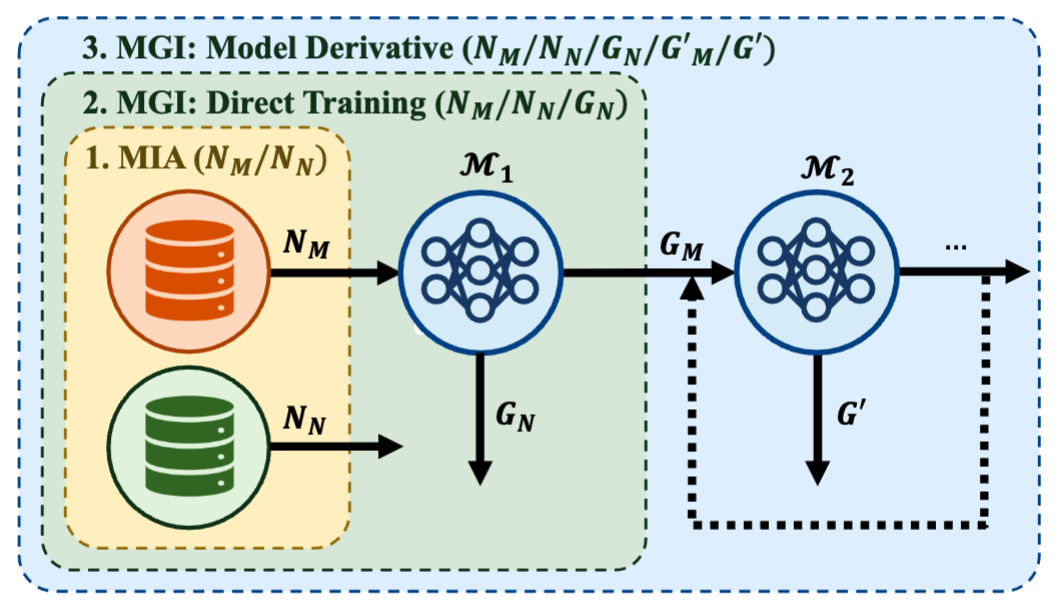
As generative models increasingly produce samples that are indistinguishable from human-created content, it becomes difficult to determine whether a given data point was part of a model’s natural training set or was generated by the model itself, especially when models memorize and reproduce training data. We formalize this challenge as Member vs Generated Inference (MGI): given a sample and a target generative model, infer whether the sample is a true training member or a generated output of that model. Focusing on image generation, we show that existing membership inference methods systematically misclassify generated samples as training members, while attribution-based methods often misclassify true members as generated. This failure arises because both approaches rely on likelihood-related signals that are similarly elevated for training examples and for the model’s own outputs. To address MGI, we propose Data Circuit Breaker (DCB), a three-stage method that combines complementary signals from a generative model’s autoencoder and latent generator to distinguish training members from generated samples. Across multiple generative models, including image autoregressive and diffusion models, DCB consistently addresses the shortcomings of membership inference and attribution methods, remains effective even when models reproduce near-duplicates of training samples, and generalizes to challenging model derivative settings in which new models are trained on generated data.
@inproceedings{zhao2026mgi, title = {MGI: Member vs Generated Inference}, author = {Zhao, Bihe and Meintz, Michel and Xu, Juangui and Boenisch, Franziska and Dziedzic, Adam}, booktitle = {European Conference on Computer Vision (ECCV)}, year = {2026}, } - Data Provenance for Image Auto-Regressive GenerationBihe Zhao, Louis Kerner, Michel Meintz, Tameem Bakr, Franziska Boenisch, and Adam DziedzicIn International Conference on Learning Representations (ICLR), 2026
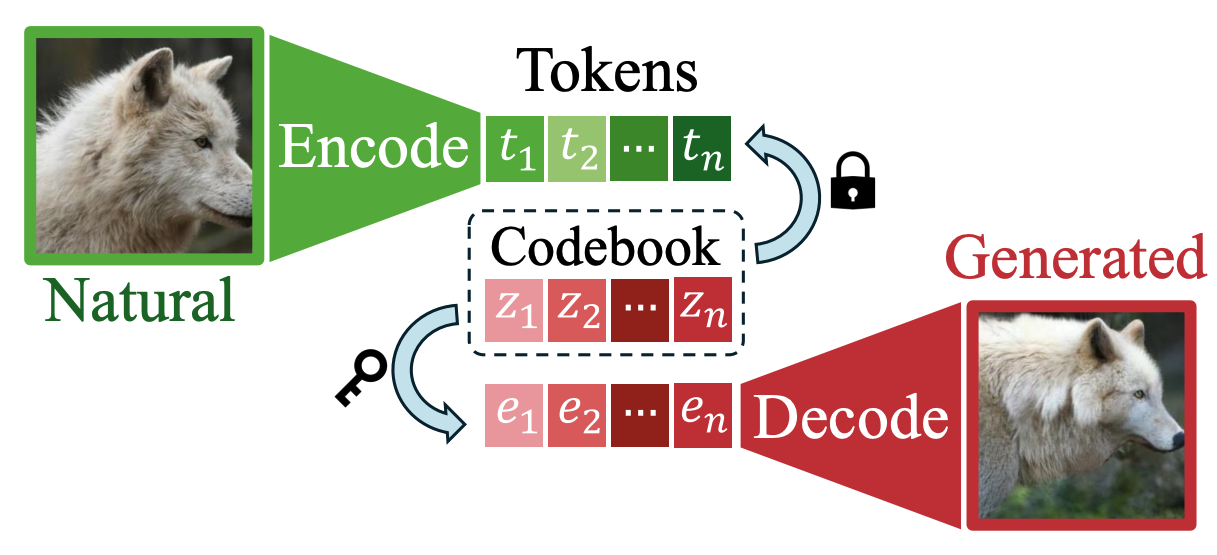
Image autoregressive models (IARs) have recently demonstrated remarkable capabilities in visual content generation, achieving photorealistic quality and rapid synthesis through the next-token prediction paradigm adapted from large language models. As these models become widely accessible, robust data provenance is required to reliably trace IAR-generated images to the source model that synthesized them. This is critical to prevent the spread of misinformation, detect fraud, and attribute harmful content. We find that although IAR-generated images often appear visually identical to real images, their generation process introduces characteristic patterns in their outputs, which serves as a reliable provenance signal for the generated images. Leveraging this, we present a post-hoc framework that enables the robust detection of such patterns for provenance tracing. Notably, our framework does not require modifications of the generative process or outputs. Thereby, it is applicable in contexts where prior watermarking methods cannot be used, such as for generated content that is already published without additional marks and for models that do not integrate watermarking. We demonstrate the effectiveness of our approach across a wide range of IARs, highlighting its high potential for robust data provenance tracing in autoregressive image generation.
@inproceedings{zhao2026provenance, title = {Data Provenance for Image Auto-Regressive Generation}, author = {Zhao, Bihe and Kerner, Louis and Meintz, Michel and Bakr, Tameem and Boenisch, Franziska and Dziedzic, Adam}, booktitle = {International Conference on Learning Representations (ICLR)}, year = {2026}, } - AgentProv: Auditing Agentic LLM API Providers via Tool-use Policy ProbesXun Wang, Bihe Zhao, Michael Backes, Franziska Boenisch, and Adam DziedzicIn Conference on Empirical Methods in Natural Language Processing (EMNLP), 2026
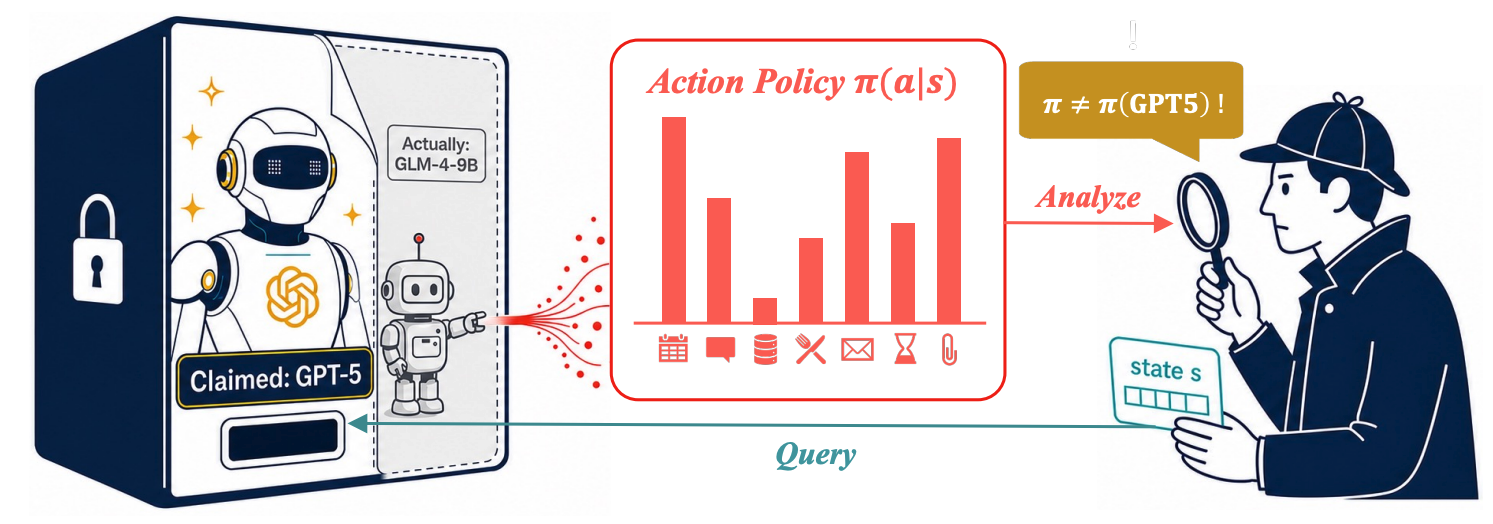
Commercial LLM APIs advertise a specific foundation model, but the served backbone may be silently substituted, quantized, or wrapped, for example to save deployment costs. All existing audits decide backbone identity from the text-output channel, which is structurally fragile for agentic APIs because modern serving stacks (OpenAI, Anthropic, Gemini, Cloudflare Workers AI, LangGraph) discard text and expose only structured actions when the model calls a tool, and provider-injected system prompts can distort text distributions enough that text-channel tests falsely accuse honest providers of substituting the claimed model. We observe that recent agentic post-training internalizes tool-use directly into the weights, opening a new audit channel that the serving stack still exposes and that is largely invariant to deployment context. We introduce Agentic Provenance (AgentProv), the first action-based identity audit for agentic LLM APIs: AgentProv fingerprints a deployed model through its categorical tool-call distribution and decides identity via an MMD permutation test. AgentProv catches every substituted model (100% on 630 evaluated checkpoint pairs), while holding the false-positive rate under system-prompt injection at 7% (vs. 67% for MET and 53% for RUT). On third-party API endpoints, AgentProv’s disagreements with MET are consistent with an independent token-count side-channel that detects provider-injected system prompts.
@inproceedings{wang2026agentprov,
  title = {AgentProv: Auditing Agentic LLM API Providers via Tool-use Policy Probes},
  author = {Wang, Xun and Zhao, Bihe and Backes, Michael and Boenisch, Franziska and Dziedzic, Adam},
  booktitle = {Conference on Empirical Methods in Natural Language Processing (EMNLP)},
  year = {2026},
}
2025
- Unlocking Post-hoc Dataset Inference with Synthetic DataBihe Zhao, Pratyush Maini, Franziska Boenisch, and Adam DziedzicIn International Conference on Machine Learning (ICML), 2025
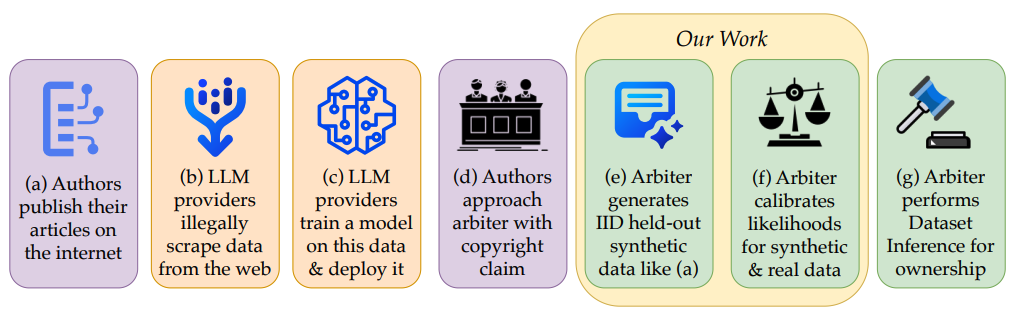
The remarkable capabilities of Large Language Models (LLMs) can be mainly attributed to their massive training datasets, which are often scraped from the internet without respecting data owners’ intellectual property rights. Dataset Inference (DI) offers a potential remedy by identifying whether a suspect dataset was used in training, thereby enabling data owners to verify unauthorized use. However, existing DI methods require a private set, known to be absent from training, that closely matches the compromised dataset’s distribution. Such in-distribution, held-out data is rarely available in practice, severely limiting the applicability of DI. In this work, we address this challenge by synthetically generating the required held-out set. Our approach tackles two key obstacles: (1) creating high-quality, diverse synthetic data that accurately reflects the original distribution, which we achieve via a data generator trained on a carefully designed suffix-based completion task, and (2) bridging likelihood gaps between real and synthetic data, which is realized through post-hoc calibration. Extensive experiments on diverse text datasets show that using our generated data as a held-out set enables DI to detect the original training sets with high confidence, while maintaining a low false positive rate. This result empowers copyright owners to make legitimate claims on data usage and demonstrates our method’s reliability for real-world litigations.
@inproceedings{zhao2025posthoc, title = {Unlocking Post-hoc Dataset Inference with Synthetic Data}, author = {Zhao, Bihe and Maini, Pratyush and Boenisch, Franziska and Dziedzic, Adam}, booktitle = {International Conference on Machine Learning (ICML)}, year = {2025}, } - BitMark: Watermarking Bitwise Autoregressive Image Generative ModelsLouis Kerner, Michel Meintz, Bihe Zhao, Franziska Boenisch, and Adam DziedzicIn Advances in Neural Information Processing Systems (NeurIPS), 2025
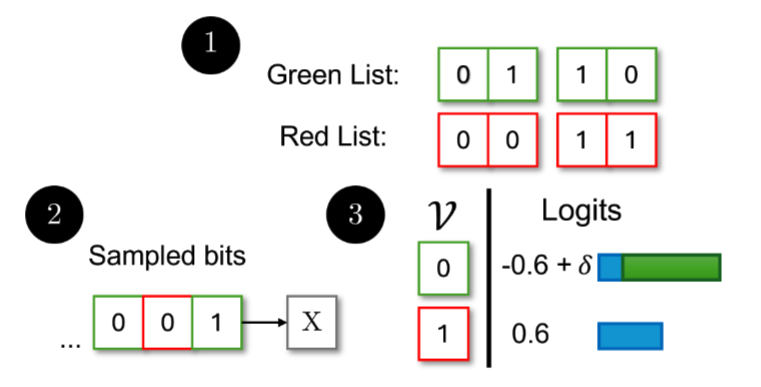
State-of-the-art text-to-image models like Infinity generate photorealistic images at an unprecedented speed. These models operate in a bitwise autoregressive manner over a discrete set of tokens that is practically infinite in size. However, their impressive generative power comes with a growing risk: as their outputs increasingly populate the Internet, they are likely to be scraped and reused as training data, potentially by the very same models. This phenomenon has been shown to lead to model collapse, where repeated training on generated content, especially from the models’ own previous versions, causes a gradual degradation in performance. A promising mitigation strategy is watermarking, which embeds human-imperceptible yet detectable signals into generated images, enabling the identification of generated content. In this work, we introduce BitMark, a robust bitwise watermarking framework for Infinity. Our method embeds a watermark directly at the bit level of the token stream across multiple scales (also referred to as resolutions) during Infinity’s image generation process. Our bitwise watermark subtly influences the bits to preserve visual fidelity and generation speed while remaining robust against a spectrum of removal techniques. Furthermore, it exhibits high radioactivity, i.e., when watermarked generated images are used to train another image generative model, this second model’s outputs will also carry the watermark. The radioactive traces remain detectable even when only fine-tuning diffusion or image autoregressive models on images watermarked with our BitMark. Overall, our approach provides a principled step toward preventing model collapse in image generative models by enabling reliable detection of generated outputs.
@inproceedings{kerner2025bitmark,
  title = {BitMark: Watermarking Bitwise Autoregressive Image Generative Models},
  author = {Kerner, Louis and Meintz, Michel and Zhao, Bihe and Boenisch, Franziska and Dziedzic, Adam},
  booktitle = {Advances in Neural Information Processing Systems (NeurIPS)},
  year = {2025},
}
2023
- New Finding and Unified Framework for Fake Image DetectionXin Deng*, Bihe Zhao*, Zhenyu Guan, and Mai XuIEEE Signal Processing Letters, 2023
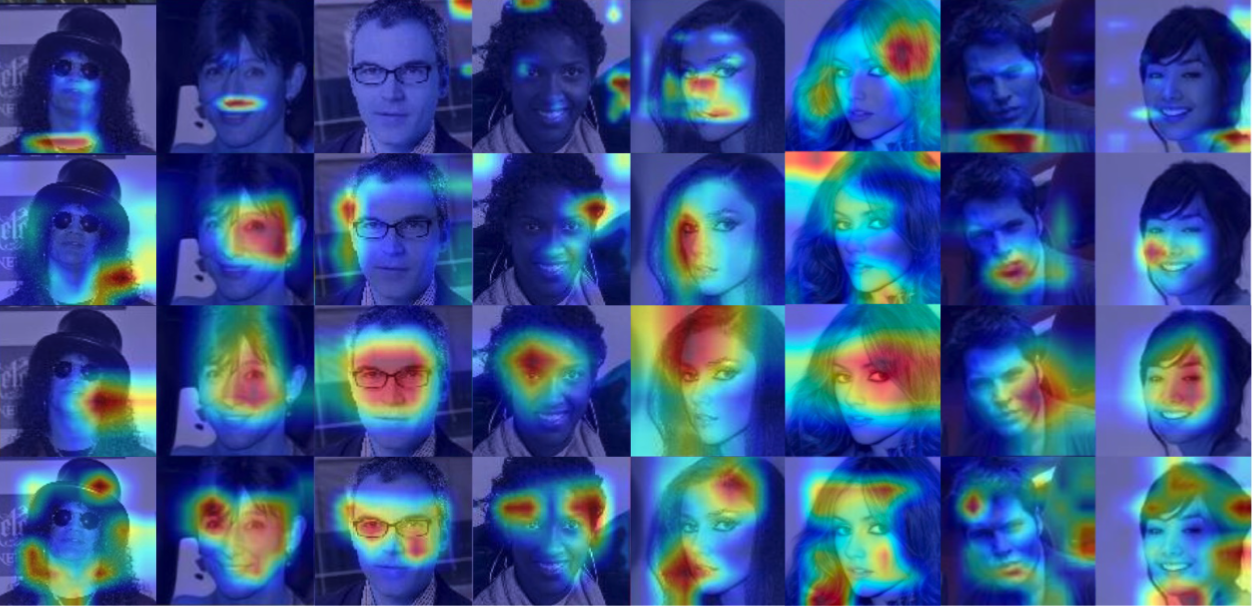
Recently, fake face images generated by generative adversarial network (GAN) have been widely spread in social networks, raising serious social concerns and security risks. To identify the fake images, the top priority is to find what properties make the fake images different from the real images. In this letter, we reveal an important observation about real/fake images, i.e., the GAN generated fake images contain stronger non-local self-similarity than the real images. Motivated by this observation, we propose a simple yet effective non-local attention based fake image detection network, namely NAFID, to distinguish GAN generated fake images from real images. Specifically, we develop a non-local feature extraction (NFE) module to extract the non-local features of the real/fake images, followed by a multi-stage classification module to distinguish the images with the extracted non-local features. Experimental results on various datasets demonstrate the superiority of our NAFID over state-of-the-art (SOTA) face forgery detection methods. More importantly, since the NFE module is independent from classification, we can plug it into any other forgery detection models. The results show that the NFE module can consistently improve the detection accuracy of other models, which verifies the universality of the proposed method.
@article{deng2023nafid,
  title = {New Finding and Unified Framework for Fake Image Detection},
  author = {Deng, Xin and Zhao, Bihe and Guan, Zhenyu and Xu, Mai},
  journal = {IEEE Signal Processing Letters},
  year = {2023},
  volume = {30},
}